
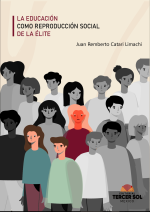
Education as social reproduction of the elite
Keywords:
social reproduction, educational reproduction, elite family, high social class, economic power, political power, políticoeducación, exclusionSynopsis
Human development is achieved through different factors such as the economy and work. In society, education is highly valued because it achieves social benefits that are then involved in obtaining a good job and thus a good salary. Likewise, through education it is possible to achieve a good social status, since with knowledge and professionalism it is possible to define a profile of a professional and efficient worker. That is why to build a better society, public policies are needed to allow access to higher quality education.
Various authors indicate an increase in access to higher education favors women, people of urban origin and ethnic origin such as whites before mestizos, followed by Afro-descendants and indigenous people. This reveals that some people, depending on their sociodemographic characteristics, have greater advantages in accessing higher education, which hinted at the existence of certain benefits for some sectors of society. On the other hand, access to education with equal opportunities and learning conditions is a commitment assumed or to be assumed by governments and private and public institutions. To this end, various laws and agreements have been proposed with foreign countries to support the process of inclusive education, since exclusion in all social and educational aspects goes against the democratization of education for the entire population and against human rights. . However, it must be said that said exclusion can occur indirectly, imperceptibly and even subtle.
Access to education enables an increase in professionals in society, which means that there will be a greater amount of professional supply for some important job positions or those required by companies and institutions, such as administrators, lawyers, engineers, doctors, politicians, among others. others. In some way, this oversupply manages to affect the high society or elite class, since they use historically exclusive professions to obtain jobs in important places.
For the elite classes to be able to obtain some educational and work places, their economic advantages and social and political influence structured from a historical social reproduction are taken into account in order to maintain their economic coffers and their high social status. Other authors recognize three spheres to achieve social reproduction: mainly, the family enables the reproduction of its class in economic and even political aspects, since another sphere is found in the State and another in public or private institutions such as hospitals and universities. schools or universities. Likewise, the authors indicate that social reproduction can be taken as an idea related to the source of economic gains, since with social reproduction the elite classes seek to create prestigious working relatives to maintain the family and its status.
However, social reproduction is involved in dynamics of inequalities and power relations that elite families build through various reproduction strategies. In other words, social life in high-class families is reproduced through social practices despite the existence of relations of inequality and domination due to direct relations between the members of said family with social structures such as the State and its institutions. . In this case, education is approached as another mechanism, as a social practice used by elites to reproduce socially.
Cite (APA)
Catari, J. (2023). La educación como reproducción social de la élite. Editorial Tercer Sol. https://submission.editorialtercersol.com/index.php/SETS/catalog/book/9
Downloads
Download data is not yet available.
Downloads
Published
July 25, 2023
Categories
Copyright (c) 2023 Submission Editorial Tercer Sol


 Av. Insurgentes sur 2387, Alcaldía Álvaro Obregón, Ciudad de México.
 Omar Roldán: contacto@editorialtercersol.com
 +52 55 56619070