Innovative alternatives of inputs for the feeding of pigs in different production systems
Keywords:
alternatives, supplies, feeding, piglets, production systemsSynopsis
According to Teixeira et al. (2018), livestock ensures the entry of protein sources for humans. In this sense, there have been enormous variations in the pastures and meadows, in the places where they are grown and raised, and, of course, in the production systems. Despite the fact that livestock has generated a reduction in many wild species in Europe, it is known that, on certain occasions, it generated more diversity in the species, in the landscapes. In current pig production, different processes are developed for the development and reproduction of these animals in order to obtain quality final products. In this sense, feeding the pigs plays an important role in such a livestock process.
In general, when an animal is fed a nutritionally balanced diet, its behavior and development is optimal. Optimal development is reflected in a healthier animal with better feeding and conversion (strictly of nitrogen and phosphorus), and, therefore, there is a reduction in environmental damage. Traditionally, in most of the world, the compounding and premixing industries provide farmers with all or part of the nutrients that animals require (Van der Poel and Marchal, 2019). After what has been indicated, it follows that food is the main economic cost of a farm, so the self-production of food is valued in the productions because it is less costly than the technical production (Argemí et al., 2018).
Pig feed must have a balanced amount of protein (essential amino acids), energy, vitamins and minerals according to the age and weight of the animal so that the proposed production goals are achieved. Therefore, it is stated that it is not the same to feed a pregnant sow as a lactating sow (Martínez and Daniel, 2016).
After what has been indicated, it is estimated that the feeding must be in accordance with the age or production phase of the animal. In this sense, the Ministry of Agriculture and Irrigation (2020) establishes that the raising of pigs is classified in different points of view: by space of the farm, by the type of feed, by the technology used, by the goals of the upbringing and, fundamentally, by the type of production or upbringing that is chosen. In this way, it can be deduced that there are several factors that are involved with pig feeding and that must be known by farmers. The producer -according to Macedo (2017)- must know the nutritional limits and inconveniences of food to use them properly and in beneficial amounts for the animal, since there is no food that contains all the nutrients necessary for vital development.
After what has been said, it is pertinent to point out that the practices that are carried out to improve nutritional gains are essential for the well-being of the health and efficiency of the production cattle. In this sense, the rations must contain the necessary and adequate nutritional requirements of energy, vitamins, minerals, proteins and water that the pigs need daily (Estévez, 2016). After the production process, the animals are transformed into food for man, therefore, Páez et al. (2018) maintain that consumers want to acquire a product of good quality and without much grade content; This forces nutritionists or pig keepers to look for new feeding alternatives for pigs in their different life stages.
After the above, it is stated that the different systems related to pig feeding have been distributed throughout the world, however, many of these generate economic expenses that certain producers cannot afford (Gómez et al., 2015). In this sense, it is pertinent to know the main characteristics of the pig, of pig farming, of the different production systems and, of course, of the nutritional alternatives that are needed for pigs.
Cite (APA)
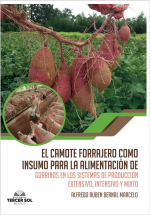
Bernal, A. (2022). El camote forrajero como insumo para la alimentación de gorrinos en los sistemas de producción extensivo, intensivo y mixto. Editorial Tercer Sol. https://submission.editorialtercersol.com/index.php/SETS/catalog/book/98
Downloads
Download data is not yet available.
Downloads
Published
December 13, 2022
Categories
Copyright (c) 2022 Submission Editorial Tercer Sol


 Av. Insurgentes sur 2387, Alcaldía Álvaro Obregón, Ciudad de México.
 Omar Roldán: contacto@editorialtercersol.com
 +52 55 56619070